
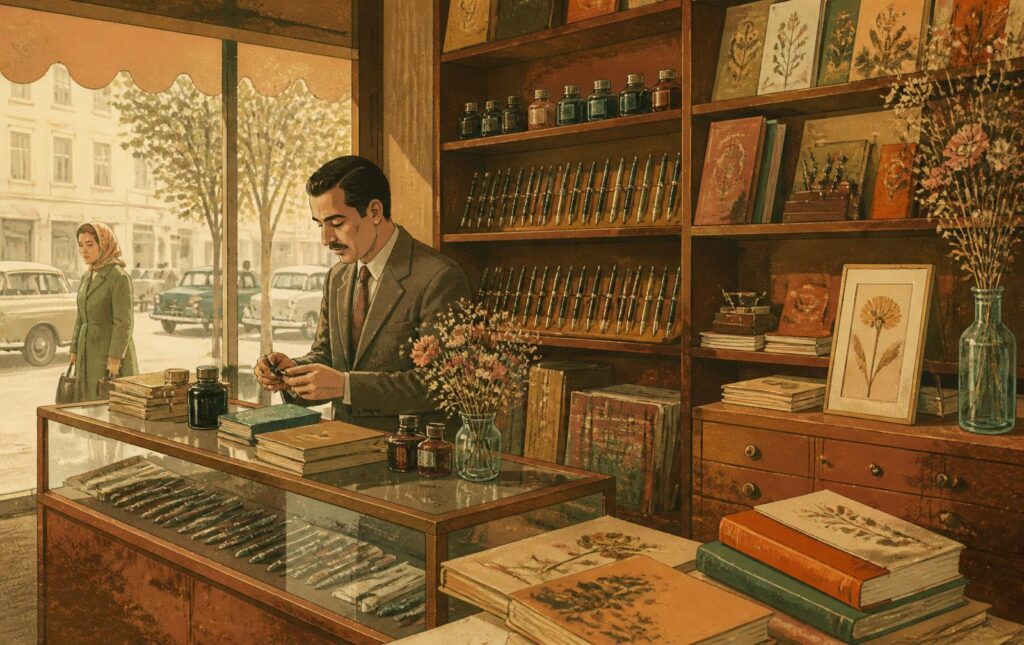
Time awaits them to find answers, eventually.
With The Stationery Shop of Tehran, Marjan Kamali presents a quintessential love story, framed over the rich cultural and political backdrop of Iran—in portrait mode.
The novel takes us into an innocent love story blooming amid the political unrest of Iran in 1953. As the nation fractures between the Shah, the Prime Minister, and competing ideologies, love quietly finds its place in an old stationery shop— between pages and poems.
While Bahman Aslan and Roya navigate the complexities of class, ambition, and longing, Kamali gently weaves the country’s culture into their journey. The shifting political landscape forms not only a nation but also the lovers’ destinies.
In an unfortunate set of events, the past intersects with the present, and nothing remains the same for the young lovers. Suddenly, a conspiracy born from an ancient, unrequited love dictates the course of their love story. With many questions left unanswered.
Deep into The Stationery Shop of Tehran, Kamali has poured all the love and pain onto the pages to illustrate the quiet power of time, without ever siding with right or wrong. History unfolds as it does—messy, painful, and deeply human.
And then the story shifts. It diverts from the passionate spark of a love that feels capable of burning down the world. Instead, the fire consumes everything except love itself.
Slowly, the writer guides the readers toward another kind of love—gentle and comforting. It arrives like a breath and stays through every season. With the scars of the past and the certainty of the future, it survives as an affirmation of a safe life.
In a twist of fate, the present intersects with the past again— as though it had always been destined to. They encountered each other like dried flowers pressed between the pages of an old diary. Preserved, but forgotten.
But did the love story complete its orbit? Must two people spend a lifetime together for their love to be called requited? That is for the readers to discover. Perhaps that is why Kamali writes, “It is a love from which we never recover.”
As the saying goes, books allow us to travel the world without ever leaving where we are. The Stationery Shop of Tehran embodies that sentiment beautifully. It transports us to the streets of Tehran, into the history, culture, and lives of its people, and leaves us carrying a love story long after the final page has been turned.
Quotes from The Stationery Shop of Tehran
> It is love from which we never recover.
> Time is not linear, but circular. There is no past, present, future. Roya was the woman she was today and the seventeen-year-old girl in the stationery shop, always.
> You might think the world is complicated and full of lost souls, that people who’ve touched your life and disappeared will never be found, but in the end all of that can change.
> She had loved him with the force of a blast. It had been impossible to imagine a future in which she didn’t hear his voice every day.
> Lovers don’t finally meet somewhere. They are in each other all along.
> There is nothing new in the world except the history you do not know. Harry Truman.
>Once you love someone, you can never really forget them; they become part of you and, in everything you do
>
Look at love
How it tangles
With the one fallen in love
Look at spirit
How it fuses with earth
Giving it new life
> Those who are young tend to think that life’s tragedies and miseries and its bullets will somehow miss them. That they can buoy themselves with naive hope and energy. They think, wrongly, that somehow youth or desire or even love can outmatch the hand of fate.
> Grateful she had known him in, grateful that once she was young, she had experienced a love so strong that it did not go away, that decades and distance and miles and children and lies and letters could never make it disappear.