
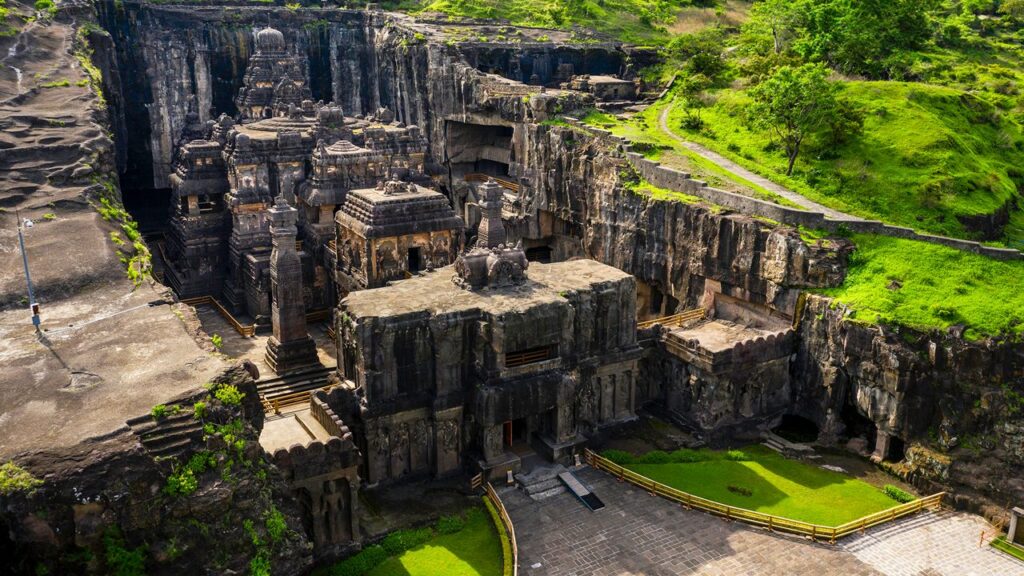
“After winning the Pushpak Viman from Kubera, Ravan was immersed in glory. Out of his love and devotion towards Lord Shiva, he decided to carry Kailash Parvat with him to Lanka, on his way back from the battle.
As he attempted to lift the mountain, Lord Shiva was engaged in a game with his consort, Parvati. Naturally, when Ravan tried to lift the mountain, everything around was thrown into disarray—even Shiva felt a slight disturbance.
Engrossed in the game, Shiva glanced below the mountain, only to find Ravan attempting to raise it on his shoulders. Shiva, being Shiva, simply pressed one of his toes down—and Ravan crumbled under the weight of Kailash”.
Now imagine this entire episode chiselled into a mountain.
That is the 16th cave of Ellora—a monolithic cliff carved around multiple Hindu mythology.
What began in the 6th century did not remain the work of a single ruler. Generations carried it forward for four centuries— shaping a symbol of syncretism. Completed in the 10th century, built with an understanding of trigonometry and astronomy, the heritage houses 34 rock-cut caves.
Ellora has twelve Buddhist caves (1–12), followed by seventeen Hindu caves (13–29), and five Jain caves (30–34): coexisiting quitely.
Perhaps the next time someone questions the relevance of trigonometry we learned in school, tell them— it is helping us to comprehend ancient marvels of India from over a millennium ago.
The Ellora Caves were among the first Indian architectural sites to be included in the UNESCO World Heritage list. In 1983. A fragment of the Kailash Temple is also inscribed on the Indian ₹20 note. It is worth noting how a masterpiece of this scale remained largely outside global attention for so long.
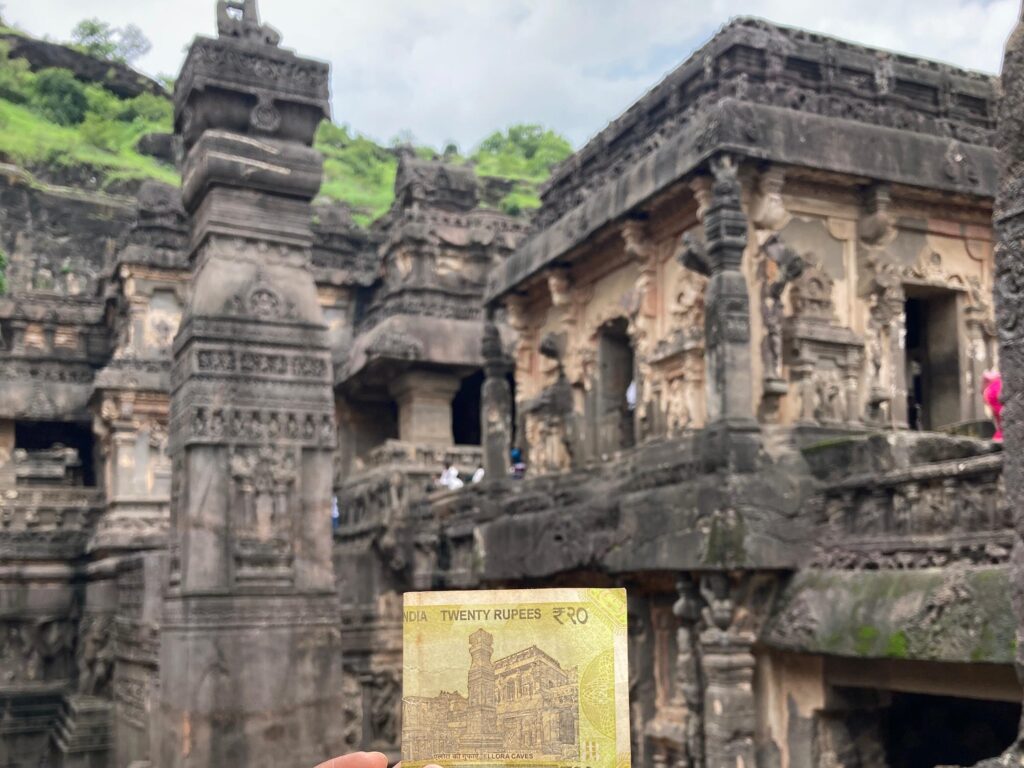
And before the world could truly turn its gaze towards the majestic Ellora Caves—time and history— had already begun to leave their marks.
As records by Ferishta suggest, the caves witnessed multiple waves of destruction between the 15th and 17th centuries. One of the most significant attacks was attributed to Aurangzeb, who reportedly employed thousands to dismantle the structure—once a shrine for the surrounding communities.
The rock endured. But the details could not.
Many sculptures, especially within the Kailash Temple, were defaced—faces erased, forms broken, stories interrupted. And yet, even in their altered state, they continue to hold meaning.
The Ellora Caves stand today—not untouched, but unbroken.
These caves are a testament to a civilisation that understood how art, technology, vision, and discipline intersect to create something enduring. Not at once, but consistently. Not in isolation, but across centuries.
That, perhaps, is the quiet strength of this place. And a page of Indian art documented in stone.
Beyond their scale and symbolism, the Ellora caves also served a simpler purpose. They were a refuge for monks travelling across the Charanandri Hills in western India. It allowed a pause in the journey. A place to rest.
Even today, the space holds that stillness.
Located near the Grishneshwar Temple—one of the twelve Jyotirlingas—Ellora Caves is not just a site you visit. It is something you experience slowly— page by page.
If you can, take a local guide along. Because as much as stories are carved into walls, many are still carried in voices.